
Hi friends, hope we’re all keeping well.
I was cleaning up my photo album the other day, and stumbled upon treasure troves of memories. I’m talking memories from holidays, summer camps, school trips, Gaeltachts, the whole shabang. It made me feel incredibly nostalgic.
It was during this cleanup that I also rediscovered photos of my black belt grading ceremony (i.e, photos of me undergoing the final trial before I received my black belt). This ceremony consisted of having to perform all of the forms, sets, and half of all the techniques that I’ve learned up to that point. Finally, we would then have to spar against all the members of the club that were in on the day, as well as facing duos and trios of them as well (this was by far the most exhausting and challenging part).
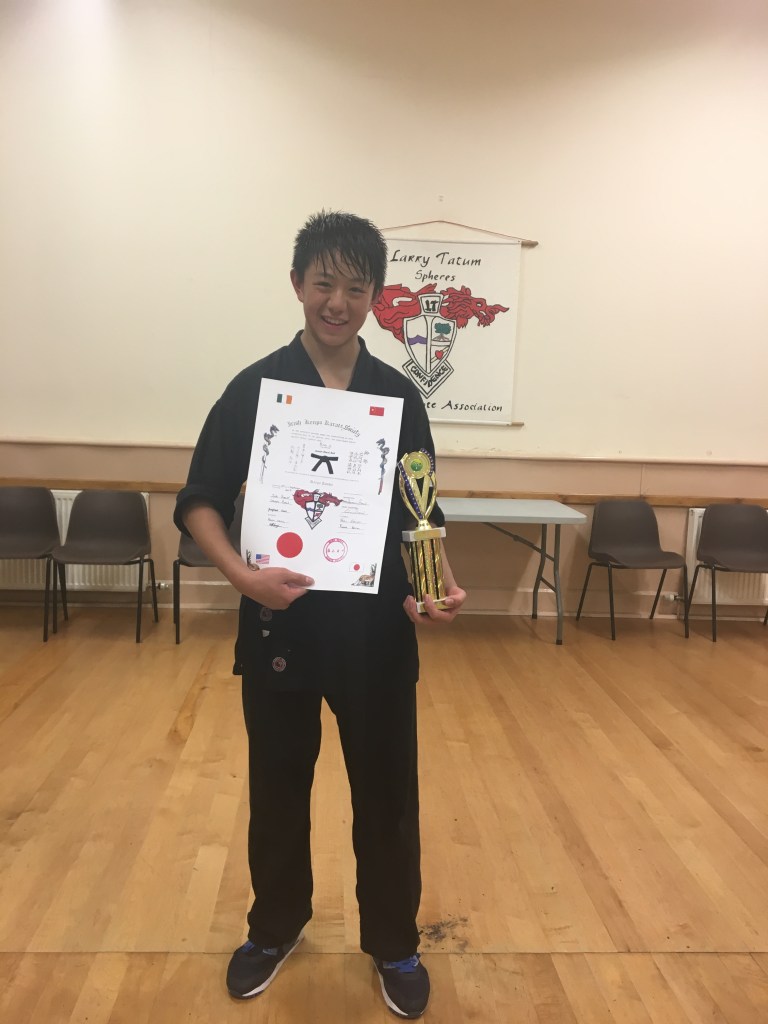
To catch you up on my history, I learned Kenpo karate for roughly 8-9 years, so basically I started when I was around 8 years old. I had to take a break from it to study for my exams in high school, but luckily managed to get my black belt before then.
The club that I joined was part of the Larry Tatum Kenpo Karate Association, so I essentially learned the Larry Tatum style techniques and forms.
🐉What is Kenpo?🐉
Since I’m too lazy to make up my own explanation, I’ll copy the Wikipedia answer for it🙃
“American Kenpo Karate (/ˈkɛnpoʊ/), also known as American Kenpo and Kenpo Karate, is an updated system of martial arts based on modern-day street fighting that applies logic and practicality. … Founded and codified by Ed Parker, American Kenpo is primarily a self-defense combat system.”
This is a nice description of it, and is basically a type of karate that gives you lots of different self defence techniques to use in different hostile situations, e.g if you’re getting kicked at, punched at, swung at, etc.
Anyone who learns Kenpo as a beginner starts off as a white belt. You advance to the next belt once you’ve learned the required techniques and form for it, which can sometimes consists of 12 separate techniques, and one entire form.
So for example, in order to get from yellow to orange, you need to learn the 12 orange belt techniques AS WELL AS Short Form 2 (one of the shortest and easiest forms to learn off). The process repeats itself as you advance to the higher belts. The picture below shows you the hierarchy of the belts:

So right now, I’m a Black Belt 1st degree, but in order to have reached this rank I had to learn off all the previous belts’ techniques and forms, I.e 106 techniques (for some reason there were 10 yellow belt techniques) as well as 6 forms (short forms 1,2,3 and long forms 1,2,3).
🥋Pros and Cons🥋
Alright, look.
There’s definitely pros and cons of picking up this style of karate. These are once again just my perceived opinions, so if you disagree with me,
You’re wrong. 🙂
Cool, let’s start with some pros.
-🏃🏻Fitness🏃🏻:I think karate helped keep me reasonably fit for the most part. In every session not only did we have to practice techniques and forms, but we also spent 10 minutes or so sparring with each other. I think this helped build up my stamina and resilience to punches.
-🤝Friendships & Memories🤝: I met some of the funniest ,wisest, and most interesting people in that karate club. I think it brought me closer to a community, which I definitely appreciate. This also helped give birth to loads of cool memories which I’ll always keep with me.
-🧠Muscle Memory💪🏼: By far the biggest pro, was that I built up some good muscle memory from back then. Every form and technique required very specific stances and positions, and you wouldn’t get by by just looking at someone doing the techniques. You had to try them out yourself, and be able to remember them.
-🛡Self-Defence🛡: I can probably reasonably defend myself in a hostile situation, if all other run and hide options aren’t available (which btw, is one of the first things my instructor taught me, to always first try run away and prevent yourself getting injured). Some techniques can definitely be viable and usable in situations, which is cool.
Alright, let’s get onto some cons of my time in that karate club now.
-👊Effectiveness👊: This is really the only con I can think of, but a common misconception that some of my friends have, whenever they hear that I have a black belt in karate, is that I’m extremely good at fighting and can kick anyone’s ass if they step up to me.
Now listen, that is absolute horse crap.😶
Like the Wikipedia definition said, Kenpo consists of mainly giving you self defence techniques to use in different situations. In an MMA setting that much more resembles a real life fight, most of these techniques would probably barely, barely see any use. The forms as well, other than looking cool and badass, don’t have much use either at the end of the day. So, honestly, I really don’t think this martial art is the most effective one out there.
Additionally, you don’t even really practice the techniques on other people until you become a black belt, so the entire time you’re practicing techniques you’re just imagining you’re doing them on others. 🤨This doesn’t really make sense to me, but that might’ve just been my club, I’m not sure. Though I suppose you don’t want little kids practising karate moves on each other, so fair enough.
🤔Was it Worth it?🤔
Overall, yeah sure. I think it was worth it. In the martial arts aspect, maybe my time could’ve been better spent in learning MMA or some other more combat-focussed martial art, but Kenpo is still definitely better than nothing.
Though possibly irrelevant, I also just had to add how sick some of the techniques sounded.
Five Swords
Flight to Freedom
Thundering Hammers
I mean, come on, they do sound badass, right? 😛😂
Cool, that’ll probably wrap up this post then. I’ll hopefully see you guys in some other post, stay safe👋🏼
 Rebellious
That is so cool you had a black belt. I did judo and really loved it when I was younger. Such a great achievement to have stuck through all the training. It takes hard work and discipline. Thank you for sharing your experience.
LikeLike
Judo sounds really cool as well, I know some people who have stuck with it as well and thoroughly enjoyed it. Thanks for commenting!
LikeLiked by 1 person
I would think it would have been well worth it, simply from the fact that you accomplished a goal that took a long time to accomplish, and one that very few people have done…
LikeLiked by 1 person
Yes, I definitely agree that it’s made me consistent and disciplined throughout the years, and even now it’s still a trait I’d like to pride myself on once in a while😁
Thank you for the kind comment!
LikeLiked by 1 person
you are welcome, and you should be proud…
LikeLike
So following your thoughts on effectiveness, I would argue that it all depends on how you were taught. Many schools teach the kata, basics and self-defense techniques and are light on sparring. While it is true the self-defense techniques should give you a leg up if you are attacked, they don’t substitute for fighting experience one gains from sparring. So it is not so much the style but the instructor and the student that is most important.
The instructor has to teach sound methods and cover all facets of fighting. The student has to do the training and soak it all in with the culmination of a black belt if one is an expert. Good luck to you.
LikeLiked by 1 person
I 100% agree with your comment. There is virtually nothing that can substitute real life combat training, or actual mentality training during a fight, other than real fighting experience.
While I may have a bit more subtle understanding of places to strike and movements to make when in a fight, that’s never going to be useful unless it’s fully soaked in and tested out in actual fighting conditions
Thanks for stopping by!
LikeLiked by 1 person
As a fellow Kenpo Black Belt, I would like to remind you that it isn’t a sport, and most aggressive situations are not a squared off fight. It is the muscle memory part that makes it effective. If your brain detects that you have been in a similar position, the targets and weapons are automatic. If you want to train to do stand up fighting, you should train also in boxing or perhaps Muay Thai. In a self defense situation, you will never get through any Kenpo technique fully. That’s because your knowledge should allow you to end the situation quickly, and you likely won’t need to square off with someone. Kenpo isn’t intended to be a sport. Be proud, keep training, and I encourage you to train in other systems as well. Ed Parker, the founder of American Kenpo had his black belts study other systems too. The more you know…….
LikeLiked by 1 person
This is a very good point, and I appreciate you mentioning them! Yes, overall it is indeed the other soft skills that Kenpo teaches that I feel ultimately becomes useful. I look back at the time I spent training and learning with nothing but pride and nostalgia! I’ll definitely also pick up a new martial art as soon as I get my driver’s license 👀
LikeLike
I have been studying kenpo as an adult for 2 years now and have my orange belt. In my club, we most definitely do practice the techniques on each other, and not just the adults. My kids go to the children’s class and they have to practice the techniques on an adult or advanced student. You certainly cannot master the techniques with practicing them in multiple partners, people of different sizes and strengths. We often do technique lines, so you get to practice the technique and the attack with many people.
LikeLike